QR Codes Built for Agriculture
From field to fork, add scannable traceability to every harvest, meet regulatory labeling mandates, and connect consumers directly to your farm story. Update QR code destinations as seasons change.
How Agriculture & Farming Use QR Codes
Practical ways to integrate QR codes into your agriculture & farming workflow, each one trackable with real-time analytics.
Farm-to-Table Traceability
Add QR codes to product packaging that link to origin details such as planting date, harvest date, farm location, and growing practices. Build consumer trust with full supply chain transparency.
Product Label Compliance
Meet emerging traceability mandates (FDA FSMA 204, EU Farm-to-Fork, India Seed Act 2026) with dynamic QR codes on packaging that link to batch records, certifications, and safety data.
Farmers Market & Direct Sales
Display QR codes at your market stand that link to online ordering, CSA sign-ups, or your farm website. Accept payments and capture customer emails with a single scan.
Equipment & Asset Tracking
Affix QR codes to tractors, irrigation systems, and tools that link to maintenance logs, manuals, and service schedules. Field crews scan to log usage or flag repairs.
Agritourism & Farm Experiences
Place QR codes along u-pick trails, barn tour routes, and farm stands that link to educational content, recipes, and event schedules, enhancing the visitor experience.
Organic & Certification Verification
Link QR codes on packaging to your USDA Organic certificate, Non-GMO Project verification, or third-party audit reports. Consumers scan to verify claims instantly.
QR Code Types for Agriculture & Farming
QRelix supports 6+ QR code types. These are the most popular for agriculture & farming:
See every scan, in real time
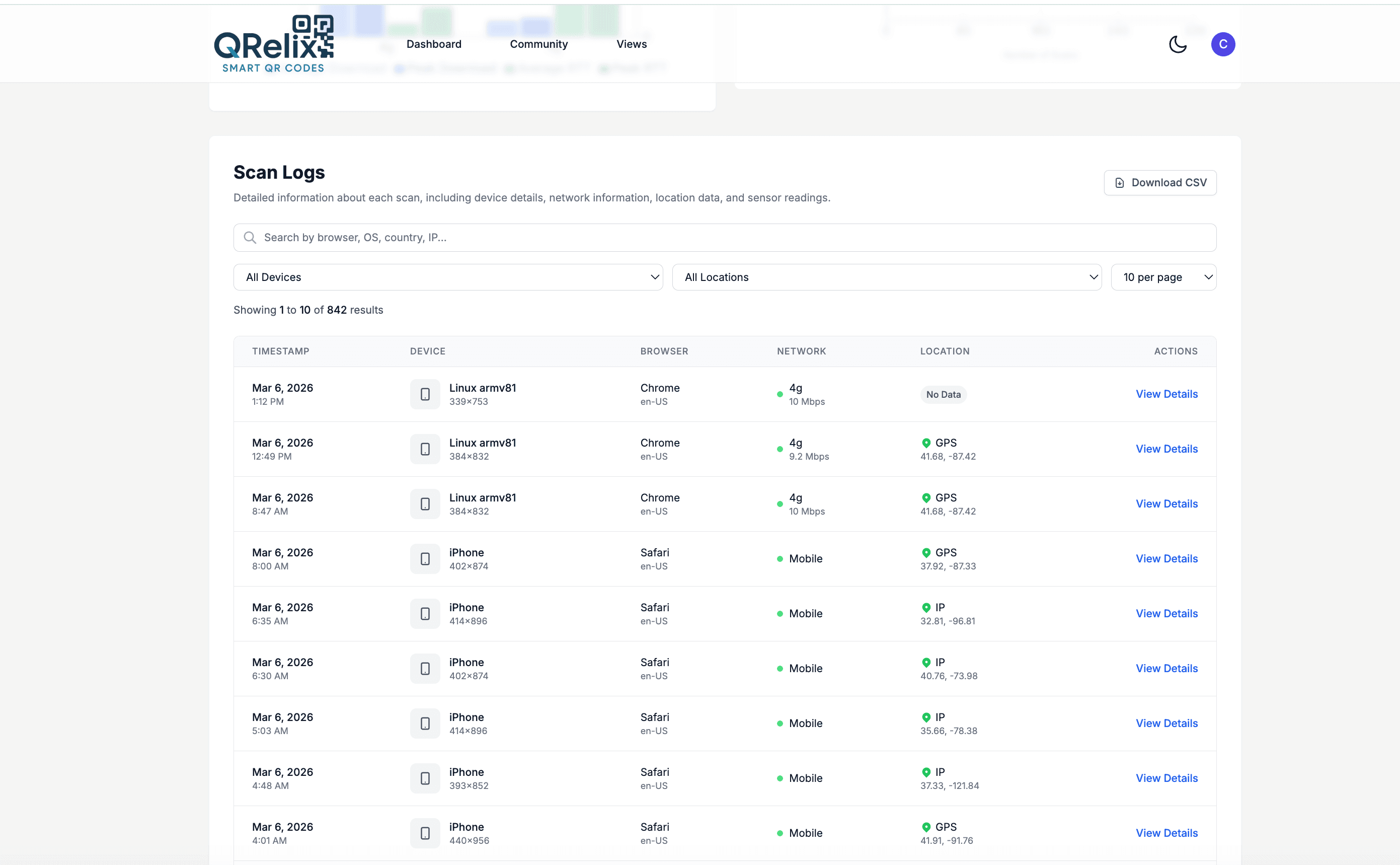
The access log turns a case label into a paper trail. Every scan of the code on a produce carton, pallet tag, or feed bag is recorded individually — timestamp, device, and location — so you can see the pallet that left the packhouse Monday getting scanned at the distributor Tuesday morning, and the same lot scanned by a shopper in a grocery aisle two states away on Friday. For a farm selling into wholesale and direct channels at once, that log is the simplest traceability record you can get without new software in the barn.
How to set up farm QR codes in 10 minutes
- 1
Create a dynamic code for each product or lot
Go to /create-qr-code and create one code per product line or lot. Use the URL type to link a farm-story or traceability page, or the File type to serve certification documents. Dynamic codes let you update what a label points to each season without touching the label design.
- 2
Add your farm's branding, keep the contrast high
Set the code's colors and embed your farm logo with the live preview. Kraft paper labels and printed cartons flatten contrast, so keep dark modules on a light background and check the preview against your actual label color. A styled code that matches your brand also reads as intentional at a farmers market table.
- 3
Print 300 DPI files on weather-resistant material
Download the 300 DPI SVG, which scales from a case sticker to a pasture-gate sign without losing sharpness. Laminate anything living outdoors — farm stand signage, equipment tags, gate signs — and place codes where hands and eyes already go: the carton end panel, the pallet tag sleeve, the market table.
- 4
Follow scans down the supply chain
In the dashboard, the scan log shows when and where each label was scanned, and the heatmap shows which regions your product reaches at retail. Use that to confirm deliveries arrived and see where buyers engage. Between seasons, edit each code's destination to the new lot's page instead of reprinting labels.
“We slap a QRelix QR code on every crate of produce. Restaurants scan it to see exactly where the food was grown and when it was picked, and it's become a selling point for our farm.”
QRelix user · Agriculture industry
Frequently Asked Questions
How are QR codes used in agriculture?
Farms use QR codes for supply chain traceability (linking packaging to origin data), regulatory compliance (meeting FDA and EU labeling mandates), direct-to-consumer sales at farmers markets, equipment tracking, and agritourism experiences. QRelix dynamic codes let you update linked content each season without reprinting labels.
Are QR codes required on agricultural products?
Increasingly, yes. The FDA's FSMA Rule 204 requires traceability records for high-risk foods, the EU Farm-to-Fork strategy encourages scannable supply chain data, and India's Seed Act 2026 mandates QR codes on seed packaging. QRelix dynamic codes make compliance easy, since you can update destination URLs as regulations evolve.
How do farmers use QR codes at farmers markets?
Farmers display QR codes at their stand linking to online stores, CSA subscription sign-ups, recipes, or farm story pages. QRelix tracks which markets and products drive the most scans, helping you focus your selling effort where it counts.
Will QR codes hold up outdoors on gates, equipment, and field signs?
The code lasts as long as the print does, so material matters more than the code itself. Print from the 300 DPI SVG onto laminated stock, aluminum, or UV-stable vinyl rather than bare paper, and keep the contrast high. Walk your gates and equipment once a season to check for sun fading, mud, and abrasion — a wipe and an occasional replacement sticker keeps every code scannable year-round.
Do QR codes work in fields and barns with no cell service?
The camera reads a code without any signal, but opening the destination page needs a connection. For codes used in dead zones — an equipment manual code in a metal barn, a lot code at a remote packhouse — print the critical details on the tag itself and let the code carry the full documentation. Where scans really matter, shop or barn WiFi closes the gap, and a WiFi QR code gets workers connected fast.
Can I use QR codes on livestock ear tags or animal records?
Yes. Create one dynamic code per animal and point it at that animal's record page — vaccination history, breeding notes, weights — wherever you keep it. Print the code small on the ear tag or stall card from the 300 DPI file, and organize the codes in the dashboard with categories by herd or barn. The scan log doubles as a handling record, showing when and where each tag was scanned.
Agriculture & Farming guides & tutorials
- QR Codes in Agriculture: The Free 2026 Playbook for Farm Traceability, Livestock & Marketing
- QR Code for Product Tracking: The Free 2026 Guide to Item-Level Traceability
- QR Code Equipment Tracking: Free Setup for Tools, Machinery & Field Gear (2026)
- QR Code Track and Trace: Free Asset, Inventory & Supply Chain Tracking (2026)
Try the free tools agriculture & farming use most
Ready to Create QR Codes for Your Agriculture & Farming?
Free, no credit card. Create dynamic, trackable QR codes in seconds. Upgrade to Pro to remove the QRelix-branded redirect shown on free scans and unlock unlimited scans.
Create QR Code Free